
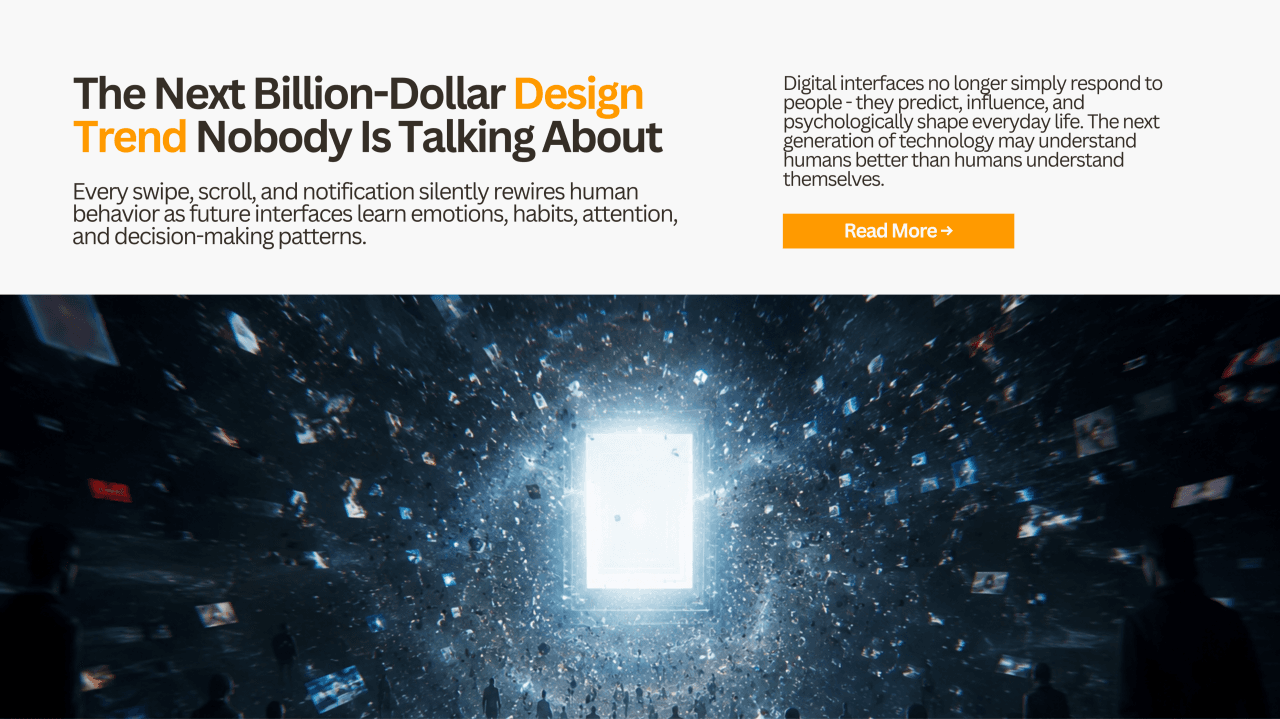

The future of interfaces is no longer about screens.
It’s about understanding humans before they act.
For the last 15 years, digital products evolved around a predictable loop:
Tap → Scroll → Click → Repeat.
But something fundamental is changing.
The next generation of interfaces will not simply respond to users. They will anticipate them.
This shift is bigger than dark mode, minimalism, AI-generated layouts, or glassmorphism. It is a complete transition from:
- static interfaces to
- adaptive intelligent environments
The products dominating the next decade may not be the ones with the most beautiful UI.
They may be the ones that:
- understand behavior,
- predict intent,
- reduce cognitive load,
- emotionally adapt,
- and disappear into human interaction itself.
And most people still don’t realize this transformation has already started.
The Death of Static Interfaces
Traditional UI design assumes:
- every user sees the same layout,
- every interaction follows the same path,
- every person behaves similarly.
But humans are not static.
A beginner and an expert do not use software the same way. An anxious user behaves differently from a confident one. A tired person navigates differently at 2 AM than during work hours.
Yet most interfaces still treat everyone identically.
That model is breaking.
Modern systems are shifting toward:
- adaptive layouts,
- behavioral prediction,
- context-aware interactions,
- AI-assisted interfaces,
- spatial computing,
- and invisible interaction models.
According to recent UI/UX trend research, adaptive interfaces and hyper-personalized experiences are becoming foundational rather than experimental. (corgenx.com)
The Rise of “Behavioral Interfaces”
The next evolution of UI is psychological.
Not visually psychological. Behaviorally psychological.
This means products are increasingly designed around:
- decision patterns,
- emotional triggers,
- dopamine loops,
- habit formation,
- trust perception,
- and cognitive reduction.
This is where design stops being decoration.
And becomes behavioral engineering.
The Psychology Behind Modern Interfaces
1. Cognitive Load Reduction
The human brain constantly seeks efficiency.
When users encounter:
- too many choices,
- dense information,
- unclear hierarchy,
- excessive motion,
- unpredictable navigation,
the brain experiences friction.
This is explained by Cognitive Load Theory, introduced by educational psychologist John Sweller.
The principle is simple:
The more mental effort required, the more likely users abandon the experience.
This is why:
- Google remained visually simple,
- Apple removed buttons,
- Netflix auto-plays content,
- Uber minimized decision steps.
The best modern interfaces reduce thinking itself.
A Reddit discussion among designers in 2026 repeatedly emphasized that the most successful interfaces are not the flashiest - they are the ones that create “less friction” and reduce user thinking. (Reddit)
2. Variable Reward Psychology
Many modern apps use behavioral reinforcement loops inspired by psychological reward systems.
This comes from B.F. Skinner’s research on variable rewards:
- unpredictable rewards create stronger habit loops than predictable ones.
Examples:
- Instagram refresh behavior,
- TikTok infinite scrolling,
- LinkedIn notification timing,
- YouTube recommendations,
- loot systems in gaming.
Users continue engaging because the brain anticipates:
“Maybe the next interaction will be rewarding.”
This is not accidental UX.
It is engineered anticipation.
3. The Zeigarnik Effect
One of the most powerful psychological principles in digital products is the Zeigarnik Effect:
Humans remember unfinished tasks better than completed ones.
Examples:
- progress bars,
- unread notifications,
- incomplete onboarding,
- streak systems,
- “Continue Watching” sections.
These systems create mental tension that pushes users back into the product.
This is why Duolingo streaks work. Why Netflix reminds you to continue watching. Why LinkedIn shows incomplete profile percentages.
The interface creates psychological incompletion.
The Shift From UI to Intelligence
Historically:
- UI was visual.
- UX became structural.
- The next layer is intelligence.
The interface is becoming dynamic.
Instead of:
“Here’s the product.”
Products are becoming:
“Here’s the version of the product optimized for you.”
Real-World Examples Already Happening
Netflix - Predictive Experience Architecture
Netflix is no longer just a streaming platform.
Its recommendation system changes:
- thumbnails,
- ordering,
- previews,
- categories,
- and behavioral timing.
Two users may see completely different emotional framing for the same content.
This is interface personalization at a psychological level.
The interface adapts to:
- watch history,
- emotional preference,
- binge behavior,
- interaction timing.
TikTok - Attention Optimization Engine
TikTok’s success was not purely algorithmic.
It mastered:
- instant gratification,
- ultra-low friction interaction,
- behavioral prediction,
- reward pacing.
The interface removes nearly every decision barrier:
- no searching required,
- no complex navigation,
- immediate stimulation.
The product predicts intent faster than users consciously express it.
Apple Vision Pro - Spatial Computing
Apple introduced the term:
“Spatial Computing.”
The important part is not the headset itself.
It is the philosophical shift.
Interfaces are moving:
- beyond screens,
- beyond rectangles,
- beyond flat interaction.
The interface becomes part of physical space.
Researchers describe spatial computing as the fusion of physical and digital environments using AI, XR, cloud systems, and real-world contextual awareness. (arXiv)
The Vision Pro interface uses:
- eye tracking,
- gesture interaction,
- environmental awareness,
- floating UI systems.
Tech reviewers described it as a “think-do interface,” where interactions feel more instinctive than traditional computing. (TechRadar)
But there’s an important reality check.
Despite technological breakthroughs, analysts reported weak mass adoption due to:
- pricing,
- comfort limitations,
- ecosystem immaturity,
- unclear everyday necessity. (The Guardian)
This matters because:
Revolutionary technology alone does not guarantee behavioral adoption.
Human psychology still decides the winner.
The Future Trend Nobody Fully Sees Yet
Emotion-Aware Interfaces
This may become the biggest interface shift of the next decade.
Future systems may adapt based on:
- stress,
- hesitation,
- voice tone,
- eye movement,
- interaction speed,
- behavioral confidence.
Imagine:
- a banking app simplifying itself when detecting confusion,
- a productivity app reducing distractions during mental fatigue,
- a learning app adapting teaching speed dynamically,
- interfaces changing communication tone depending on emotional state.
This is no longer science fiction.
The infrastructure already exists:
- AI,
- biometric sensors,
- eye tracking,
- contextual computing,
- behavioral analytics.
The real challenge is ethics.
The Dangerous Side of Adaptive Design
The same systems that improve experiences can also manipulate behavior.
And this is where the future becomes complicated.
A 2025 analysis on AI personalization warned about “deep tailoring” - systems that adapt persuasive messaging based on psychological profiling. (Time)
This moves beyond:
- targeted ads,
- recommendation systems,
- personalization.
Into:
- identity-based persuasion,
- emotional targeting,
- subconscious influence.
Future interfaces may know:
- what scares users,
- what motivates them,
- what emotional language influences them most.
This creates an enormous ethical question:
At what point does personalization become manipulation?
Designers, founders, and AI companies will eventually face regulations around:
- dark patterns,
- behavioral exploitation,
- addictive UX systems,
- emotional surveillance.
The future of design may become less about creativity - and more about responsibility.
Why Minimalism Is Evolving Again
For years, minimalism dominated design.
But now users expect interfaces to feel:
- intelligent,
- alive,
- responsive,
- contextual.
Minimalism alone is no longer enough.
According to ongoing design discussions and trend reports:
- users still prefer simplicity,
- but now expect intelligent interaction layered underneath. (Reddit)
This creates a new design philosophy:
“Invisible Complexity”
Where:
- the system itself is advanced,
- but the experience feels effortless.
The complexity moves behind the interface.
The best UX increasingly feels:
- natural,
- predictive,
- emotionally calm.
Not visually overloaded.
The Most Important Prediction
The next billion-dollar interface may not look futuristic at all.
It may feel:
- quieter,
- calmer,
- more human,
- almost invisible.
Because the future of UX is not about adding more interaction.
It is about removing unnecessary interaction entirely.
The strongest products of the next decade may:
- reduce decisions,
- eliminate friction,
- predict needs,
- adapt silently,
- and blend into human behavior itself.
The interface disappears.
The experience remains.
Final Thought
For years, the tech industry competed on:
- features,
- visuals,
- speed,
- aesthetics.
The next competition may be different.
It may center around:
Which product understands humans best.
And the companies that master that balance - between intelligence, psychology, ethics, and simplicity - may define the next era of digital experiences.
Notes & References
- Spatial computing analysis and Vision Pro interface observations (TechRadar)
- Adaptive and AI-driven interface trends (corgenx.com)
- Ethical concerns around AI personalization (Time)
- Community UX observations and practical design trends (Reddit)
— Vishal M
Founder & CEO at Vepzo Design Studio
Continue the Conversation
This article was originally published on LinkedIn.
What are your thoughts on this topic?
I'd love to hear your perspective.