
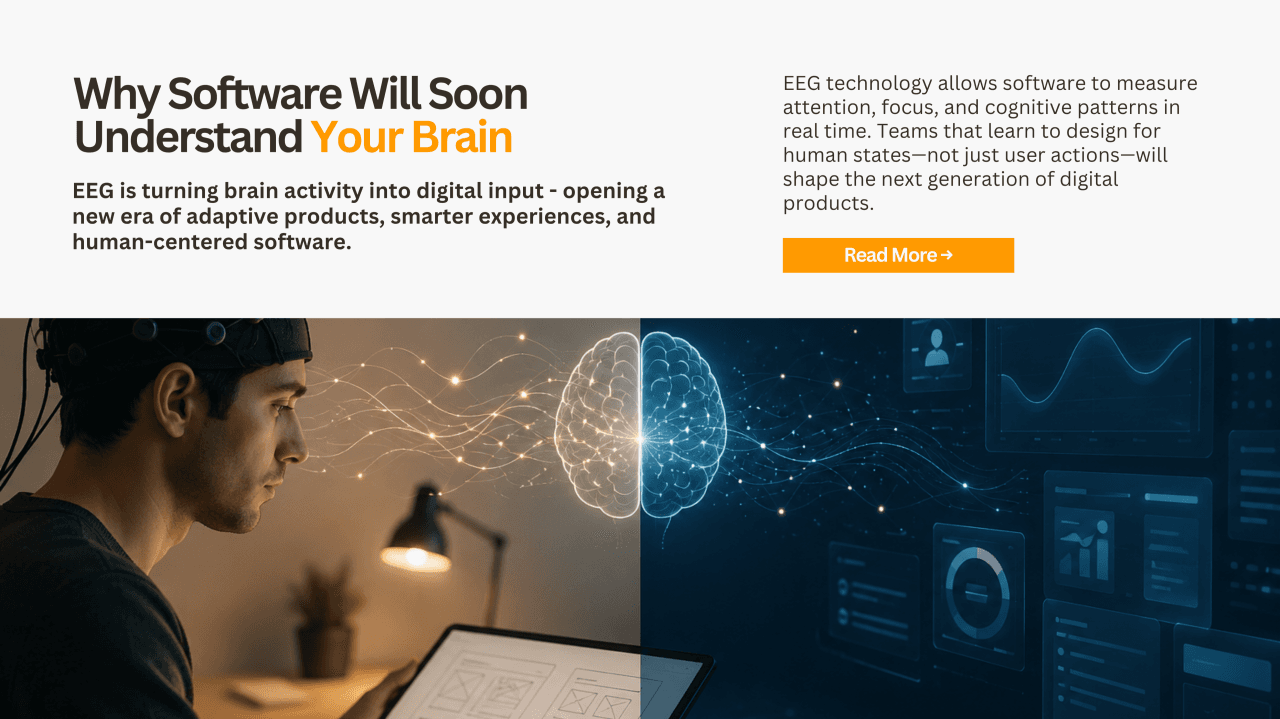

We moved from keyboards → touch �� voice. What comes next?
For decades, software evolved around physical interaction.
We typed commands. Then we clicked interfaces. Then we touched screens. Then we started talking to software.
But a new interaction layer is emerging quietly inside research labs, startups, healthcare systems, and consumer devices:
Software that understands the human brain directly.
This technology is powered by EEG - Electroencephalography.
EEG is not science fiction. It already powers medical diagnosis, gaming experiments, accessibility systems, sleep technologies, cognitive monitoring, and the first generation of brain-computer interfaces (BCI).
The question is no longer:
"Can software understand brain signals?"
The question becoming relevant for designers and builders is:
"What happens when software starts responding before users even act?"
Understanding EEG - Listening to Electrical Activity of the Brain
EEG (Electroencephalography) is a method used to measure the electrical activity generated by neurons inside the brain.
Every time groups of neurons communicate, they generate microscopic electrical signals.
EEG captures these signals using electrodes placed on the scalp.
Unlike MRI or CT scans that visualize structure, EEG measures brain activity in real time.
The captured signals are extremely small.
Typical EEG readings operate in:
10–100 microvolts (μV)
That is thousands of times smaller than the electricity powering your laptop.
Yet inside these tiny fluctuations exists information related to:
- Attention
- Cognitive workload
- Sleep stages
- Emotional states
- Memory engagement
- Motor intention
- Visual processing
- Decision-making patterns
EEG became widely adopted because it is:
- Non-invasive
- Safe
- Relatively affordable
- High temporal resolution (millisecond-level)
Modern systems can sample signals hundreds or thousands of times every second.
How EEG Actually Works
Imagine your brain as billions of people talking inside a stadium.
EEG cannot hear every individual voice.
Instead, it measures the overall crowd behavior.
The process looks like this:
Step 1 - Electrode Placement
Electrodes are positioned using standardized systems such as:
10–20 Electrode Placement System
This maps regions like:
Frontal (Decision Making) Temporal (Memory & Hearing) Parietal (Sensory Processing) Occipital (Vision)
Each location records slightly different neural patterns.
Electrodes are positioned using standardized systems such as the 10–20 Electrode Placement System.
Step 2 - Signal Acquisition
Electrical fluctuations are captured continuously.
Raw EEG looks noisy because signals include:
- Eye blinking
- Facial movement
- Muscle activity
- Environmental electrical interference
Electrical fluctuations are captured continuously.
Step 3 - Signal Processing
Software pipelines then clean and transform signals.
Typical processing includes:
- Band-pass filtering
- Artifact removal
- Feature extraction
- Classification using AI models
This converts electrical activity into usable digital outputs.
Step 4 - Interpretation
Software maps patterns into actions.
Examples:
Brain Pattern → Software Response
Focused → Reduce notifications Stress → Simplify interface Motor intention → Move cursor Sleep stage → Trigger adaptive audio
This is where neuroscience becomes product design.
Reading Brainwaves - The Hidden Language Inside EEG
EEG signals are often grouped into frequency bands.
Delta (0.5–4 Hz)
Deep sleep and restoration
Theta (4–8 Hz)
Creativity, meditation, memory processing
Alpha (8–13 Hz)
Relaxation and calm focus
Beta (13–30 Hz)
Problem solving and active concentration
Gamma (30–100 Hz)
Complex thinking and information integration
These patterns continuously shift every second.
Software systems increasingly learn to interpret those transitions.
Where EEG Is Already Being Used Today
Many people still associate EEG with hospitals.
That is changing rapidly.
Healthcare
EEG remains one of the primary tools for:
- Epilepsy monitoring
- Sleep disorder analysis
- Brain injury assessment
- Neurological diagnostics
Accessibility & Brain-Computer Interfaces
Users with severe motor limitations can already interact using neural activity.
Modern BCI systems translate EEG into:
- Cursor movement
- Text selection
- Communication interfaces
Recent software platforms are making EEG training accessible to non-technical users rather than limiting usage to research labs.
Consumer Wearables
Portable EEG devices are becoming smaller and more practical.
Emerging categories include:
- Sleep wearables
- Focus tracking
- Productivity analytics
- Cognitive monitoring
The transition happening now is similar to what happened with smartwatches.
First: research. Then: enthusiasts. Then: consumer products.
Portable EEG devices are becoming smaller and more practical.
Gaming and Immersive Experiences
Gaming companies have started experimenting with EEG-enabled experiences.
Imagine:
Difficulty adjusts to your cognitive load.
Music reacts to emotional intensity.
NPCs adapt based on attention.
Not from clicks.
From neural state.
The Current Research That Could Change Software Forever
Several major developments are pushing EEG beyond laboratories.
Consumer EEG + Remote Data Collection
Researchers recently demonstrated platforms capable of collecting high-quality EEG remotely using consumer wearables.
This enables large-scale cognitive studies outside clinical environments.
That means software products may eventually train on real-world cognitive behavior rather than artificial lab sessions.
AI Models Built Specifically for EEG
Deep learning architectures are now being designed specifically for EEG interpretation.
Instead of manual signal analysis, models learn patterns directly from brain activity.
This reduces calibration effort and increases scalability.
Transfer Learning for Brain Interfaces
Traditional EEG systems required lengthy user training.
New approaches attempt to transfer learning across users and devices.
Goal:
Wear headset → Start using immediately.
That shift is essential for mass-market adoption.
Goal: Wear headset → Start using immediately.
The Software Product Revolution: From Reactive UI to Predictive UI
This is where things become exciting for product teams.
Today:
User → Action → System Response
Tomorrow:
Brain State → Prediction → Adaptive Interface
Imagine software products that can:
Productivity Platforms
Detect overload and reduce complexity.
Learning Platforms
Measure engagement and adjust content difficulty.
E-commerce
Adapt recommendations to attention.
Creative Tools
Change interface density during flow state.
Health Apps
Track burnout before users report it.
Operating Systems
Become context-aware continuously.
This creates a new category:
Neuro-Adaptive Software.
Not software users operate.
Software that evolves with users.
The UX Questions Nobody Can Ignore
EEG-enabled software creates difficult design questions.
Should interfaces react automatically?
Who owns neural data?
What level of prediction feels useful vs uncomfortable?
Should users see what the system inferred?
Brain data may become one of the most sensitive categories of digital information.
Trust will become a product feature.
What Designers and Builders Should Start Doing Today
Software teams do not need EEG hardware tomorrow.
But they should prepare their thinking.
1. Design for Cognitive Load
Measure effort, not just clicks.
2. Build Adaptive Interfaces
Interfaces should respond to user state.
3. Move Beyond Traditional Analytics
Behavior analytics alone will not be enough.
4. Think Multimodal
Combine:
- Interaction
- Context
- Environment
- Physiological feedback
5. Design Ethical Intelligence
Consent must become visible.
Final Thought
The biggest shift in software history was not better interfaces.
It was reducing the distance between intention and action.
Touch reduced that distance.
Voice reduced it further.
EEG may reduce it again.
The future may not belong to software that users operate.
It may belong to software that understands people before they ask.
And when that happens - UX will no longer mean User Experience.
It may become Human Experience.
— Vishal M
Founder & CEO at Vepzo Design Studio
Continue the Conversation
This article was originally published on LinkedIn.
What are your thoughts on this topic?
I'd love to hear your perspective.