
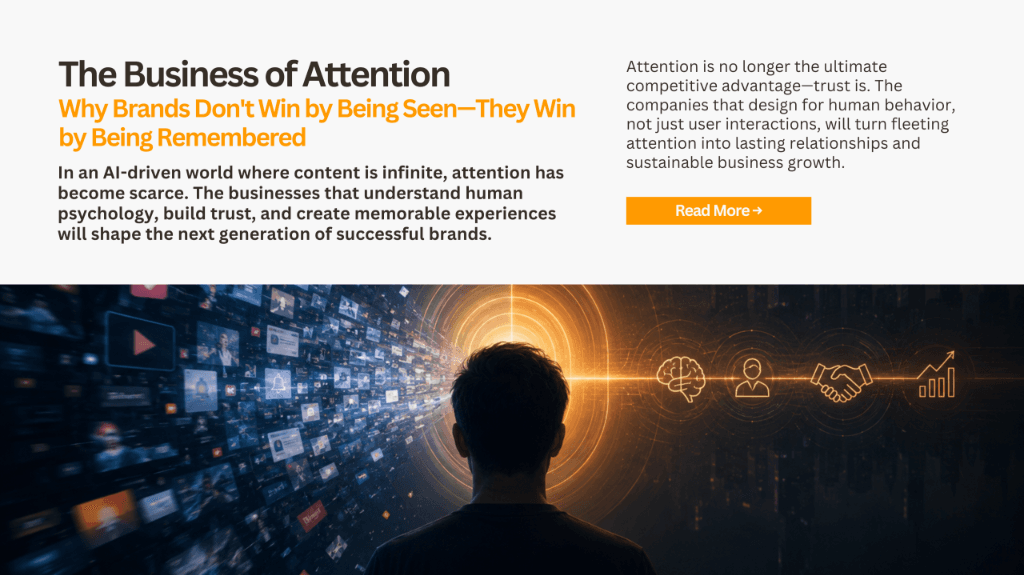

Why the Companies Winning Tomorrow Aren't Fighting for Clicks - They're Earning Minds
"In an information-rich world, the wealth of information means a poverty of attention." - Herbert A. Simon, Nobel Laureate (1971)
Every day, the average person wakes up to hundreds of notifications, emails, advertisements, videos, and messages competing for one thing - their attention.
Yet something fascinating is happening.
Despite having more content than ever before, businesses are finding it harder to capture customers.
The problem isn't that companies aren't creating enough content.
The problem is that they're creating too much of it.
Welcome to the Attention Economy, where attention has become one of the world's most valuable and limited resources.
But here's the twist.
The companies that will dominate the next decade aren't the ones getting the most attention.
They're the ones turning attention into trust.
The World's Most Expensive Commodity Isn't Oil. It's Human Attention.
For decades, economists believed land, labor, and capital were the primary drivers of economic value.
Today, another resource has quietly become even more valuable.
Attention.
Unlike money, attention cannot be stored.
Unlike time, it cannot be borrowed.
Unlike technology, it cannot be copied.
Every person gets roughly 16 waking hours a day, and every company - from Netflix to LinkedIn, Apple to TikTok - is competing for the same finite resource.
The challenge isn't producing content anymore.
AI can generate thousands of articles in minutes.
Design tools can produce hundreds of visuals instantly.
Marketing automation can publish campaigns around the clock.
Supply has become infinite.
Human attention hasn't.
The Attention Paradox
In 2025, more than 400 million terabytes of data are created every day globally.
Thousands of businesses publish blog posts every minute.
Millions of videos are uploaded every day.
Generative AI has multiplied content production dramatically.
Yet customer attention continues to decline.
Research from Microsoft found that sustained attention on digital media has shortened over the last decade, while interruptions have become increasingly frequent. Meanwhile, cognitive science consistently shows that working memory can actively process only a limited amount of information at once.
The implication is simple.
Information abundance creates attention scarcity.
Every additional piece of content doesn't increase visibility.
It increases competition.
The Psychology Behind Why We Can't Look Away
Why do we check Instagram without thinking?
Why does TikTok somehow turn five minutes into fifty?
The answer isn't luck.
It's behavioral psychology.
Variable Rewards
Psychologist B.F. Skinner discovered that unpredictable rewards create stronger habits than predictable ones.
Slot machines use this principle.
So does social media.
Every refresh might reveal:
- a viral post
- an important message
- exciting news
- unexpected recognition
Your brain keeps checking because it never knows when the reward will appear.
Dopamine Isn't Happiness
Contrary to popular belief, dopamine isn't the "pleasure chemical."
Neuroscientists describe dopamine primarily as a motivation signal—it encourages us to seek the next potential reward.
Platforms optimize for anticipation, not satisfaction.
That's why endless scrolling feels productive while leaving us mentally exhausted.
The Companies That Mastered Attention
Let's look beyond the interfaces.
TikTok
Most people believe TikTok's success comes from short videos.
It doesn't.
Its real innovation is prediction.
Every swipe teaches the recommendation system something about you.
Within minutes, your feed becomes uniquely yours.
Users don't stay because videos are short.
They stay because the next video feels increasingly relevant.
Netflix
Netflix invests billions not only in producing content but also in helping people discover it.
Personalized artwork.
Personalized recommendations.
Preview trailers.
Even thumbnails change depending on viewing behavior.
The objective isn't simply to entertain.
It's to reduce the friction between curiosity and action.
Apple
Apple rarely competes on specifications.
Instead, it competes on perception.
Minimal packaging.
Clean interfaces.
Consistent typography.
Predictable interactions.
Every design decision communicates the same message:
"You can trust this product."
That's not decoration.
That's strategic design.
The Biggest Mistake Businesses Make
Many businesses confuse attention metrics with business metrics.
"We reached one million people."
"We got 100,000 views."
"We gained 20,000 followers."
Those numbers feel impressive.
But here's the uncomfortable question:
How many people remembered you a week later?
Attention without memory creates noise.
Memory creates brands.
Brand recall creates revenue.
What Actually Makes People Remember?
Psychologists have long studied why certain experiences stay with us while others disappear.
Three factors consistently stand out:
Emotion
People rarely remember information.
They remember how something made them feel.
This is why powerful stories outperform feature lists.
Simplicity
The human brain prefers clarity over complexity.
Apple's "Think Different."
Nike's "Just Do It."
Stripe's product pages.
Simple ideas travel further because they're easier to remember.
Consistency
Trust isn't built through one interaction.
It's built through hundreds of predictable ones.
Every touchpoint either strengthens or weakens perception.
Your website.
Your emails.
Your proposals.
Your onboarding.
Your customer support.
Design isn't just visual consistency - it's behavioral consistency.
From Attention to Trust
This is where many businesses stop.
They optimize for clicks.
The best businesses optimize for confidence.
Anyone can buy impressions.
Anyone can create viral content.
Very few can build trust at scale.
Trust is created when every interaction answers the same silent question:
"Can I rely on you?"
Design answers it visually.
Products answer it functionally.
Brands answer it emotionally.
What This Means for Businesses
As AI makes content creation faster and cheaper, attention alone becomes less valuable.
If everyone can produce content, content is no longer the competitive advantage.
Thinking is.
Understanding people is.
Building trust is.
The businesses that win won't necessarily publish more.
They'll publish with greater clarity.
They won't design prettier interfaces.
They'll design experiences that reduce uncertainty.
They won't chase algorithms.
They'll earn credibility.
The Next Generation of Business
At Vepzo, we don't see design as the final step of building a product.
We see it as the bridge between business strategy and human psychology.
A website isn't just a digital brochure.
An app isn't just a collection of screens.
Every interaction shapes perception.
Every perception influences trust.
Every moment of trust influences business growth.
In the coming years, businesses will spend billions trying to capture attention.
The truly exceptional ones will invest in something far more valuable:
Keeping it.
Because attention opens the door.
Trust keeps people inside.
And in an AI-driven world where everything can be generated, trust will become the rarest - and most valuable - competitive advantage.
A Question Worth Thinking About
If your customers remembered only one thing about your business after leaving your website today...
Would it be your product, your price, or the trust your brand made them feel?
— Vishal M
Founder & CEO at Vepzo Design Studio
Continue the Conversation
This article was originally published on LinkedIn.
What are your thoughts on this topic?
I'd love to hear your perspective.