

Artificial intelligence is no longer something we simply experiment with. It has quietly become part of how we work, communicate, create, and make decisions every day.
For many of us, tools like Google Workspace, Slack, Notion, and increasingly ChatGPT have moved from being optional tools to becoming part of our professional routine.
I’ll be honest — I was skeptical at first.
Like many professionals, I initially saw AI as a shortcut: useful for saving time, but not something I would fundamentally depend on.
That changed.
AI didn’t just start assisting my work. It gradually started influencing how I think, plan, create, and execute.
And eventually, that made me stop and ask:
Are we using AI to become better thinkers — or are we slowly allowing it to think for us?
The Real Numbers Behind AI Adoption
What I experienced personally is part of a much larger shift.
According to McKinsey’s Global AI Survey (2024), organizations are increasingly reporting productivity, decision-making, and creativity benefits from generative AI adoption.
Gartner has also projected significant growth in AI augmentation across routine professional tasks, while Microsoft’s Work Trend Index highlights the amount of time employees can potentially save by using AI for repetitive cognitive work.
The direction is clear.
AI isn't simply replacing individual tasks. It is changing the way work itself is performed.
And that change is happening faster than many of us expected.
How I Personally Use ChatGPT
My first interactions with ChatGPT were fairly simple.
I used it for:
- Generating rough ideas
- Rewriting content
- Creating basic to-do lists
- Exploring unfamiliar topics
But as my responsibilities grew — particularly as a founder — my use of AI expanded with them.
Today, ChatGPT has become part of my daily workflow.
I use it for:
- Brainstorming UI/UX flows and product concepts
- Exploring product and business ideas
- Drafting LinkedIn posts and newsletters
- Developing brand messaging
- Writing promotional and explainer scripts
- Breaking down technical and strategic concepts
- Structuring documentation and proposals
- Building workflows
- Exploring solutions to complex planning and logic problems
I now use AI daily, often multiple times a day.
In practical terms, it can save me 20–30 minutes on many individual tasks.
That may not sound significant in isolation.
But repeated across days, weeks, and months, those minutes become hours — and eventually a meaningful productivity advantage.
Especially when you're working in a fast-moving startup environment.
But Is This a Strength or a Risk?
This is where things become more interesting.
AI is incredibly powerful.
But power without awareness creates dependency.
The upside
Used intentionally, AI can help us:
- Generate ideas faster
- Reduce repetitive mental workload
- Structure unclear thoughts
- Communicate more effectively
- Explore unfamiliar subjects quickly
- Move from idea to execution faster
It gives us more time to focus on higher-level decisions.
But there is another side that deserves much more attention.
The risk we don't talk about enough
When AI always provides the first answer, we may stop developing our own first answer.
When AI removes every moment of creative friction, we may lose some of the struggle that produces original ideas.
And when speed becomes the primary measure of productivity, depth can quietly disappear.
I've experienced this myself.
There have been situations where:
- An AI-generated UI pattern didn't actually fit the user's needs.
- Context was interpreted incorrectly.
- An answer sounded convincing but lacked meaningful depth.
- A seemingly good solution didn't account for the real-world constraints.
The output wasn't necessarily wrong.
It simply wasn't thoughtful enough.
That's an important distinction.
And it led me to one realization:
AI doesn't think for us. It reflects what we give it.
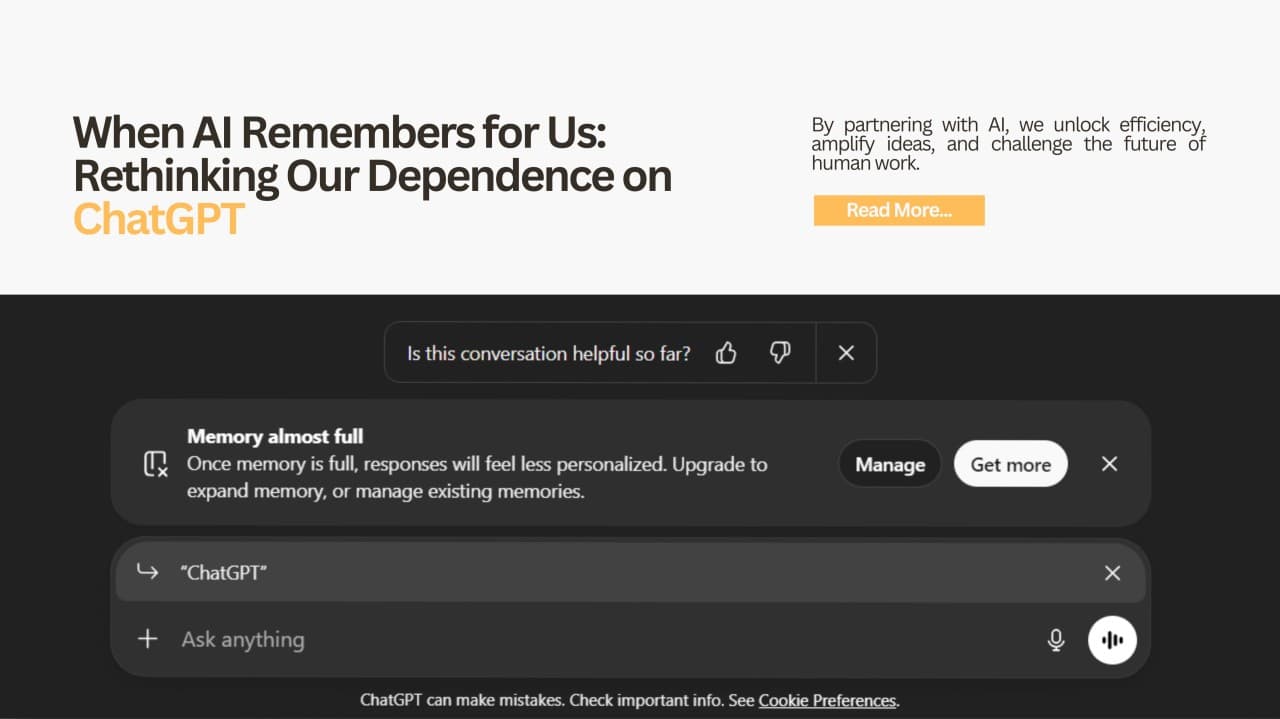
“Memory Almost Full” — A Surprisingly Human Metaphor
One message from ChatGPT recently caught my attention:
“Memory almost full. Responses may feel less personalized.”
Technically, it was simply a system message.
But I couldn't help seeing something deeper in it.
AI depends heavily on context. The more relevant context it has, the more useful and personalized its responses can become. When context is missing or constrained, the quality of the interaction can change.
Humans aren't so different.
Our experiences, memories, observations, failures, and accumulated knowledge shape the way we think.
And when we outsource too much of that thinking, something subtle can happen.
Our own mental models can become weaker.
We stop wrestling with questions.
We stop forming opinions before asking for answers.
We stop experiencing the productive discomfort that comes from figuring something out ourselves.
And eventually, convenience can become dependency.
Finding the Right Balance
I don't believe the answer is to use AI less.
I believe the answer is to use it more intentionally.
For me, that means following a few principles.
1. Treat AI as an assistant, not an authority
AI can generate an answer.
That doesn't automatically make the answer correct.
Human judgment still matters.
2. Use AI to accelerate thinking — not avoid it
There is a difference between asking:
“Give me the answer.”
and asking:
“Help me explore this problem.”
The second approach keeps you involved in the thinking process.
3. Question the output
Don't accept an answer simply because it sounds intelligent.
Challenge it.
Ask why.
Look for assumptions.
Test it against reality.
4. Keep creative friction alive
Not every difficult moment needs to be automated.
Sometimes struggling with a problem is exactly how we develop better judgment.
5. Let humans make the important decisions
AI can provide possibilities.
But values, context, responsibility, empathy, and judgment still belong to us.
The Future Isn't Human vs. AI
I don't think the future of work will be a simple competition between humans and artificial intelligence.
The more interesting future is human + AI.
The people who benefit most won't necessarily be those who automate everything.
They'll be the people who know:
- What to delegate
- What to question
- What to verify
- What to create themselves
- And when human judgment matters most
The real advantage isn't automation alone.
It's orchestration — knowing how to direct intelligent tools toward meaningful outcomes.
Final Reflection
AI is powerful.
AI is efficient.
AI is transformative.
But dependency without awareness is dangerous.
The question isn't whether AI will shape the future of work.
It already has.
The question is:
Are we shaping AI with intention, or are we allowing AI to reshape how we think?
For me, the answer is still evolving.
I use AI every day. I rely on it heavily. And I also know that I need to keep questioning it.
Because the goal shouldn't be to become more like machines.
The goal should be to use machines to become more capable humans.
The future belongs to people who remain curious, critical, creative, and consciously human — even while working alongside increasingly intelligent machines.
Continue the Conversation
This article was originally published on LinkedIn.
What is your relationship with AI?
Do you use it as a productivity tool, a thinking partner, or something you increasingly depend on?
I'd love to hear your perspective.